
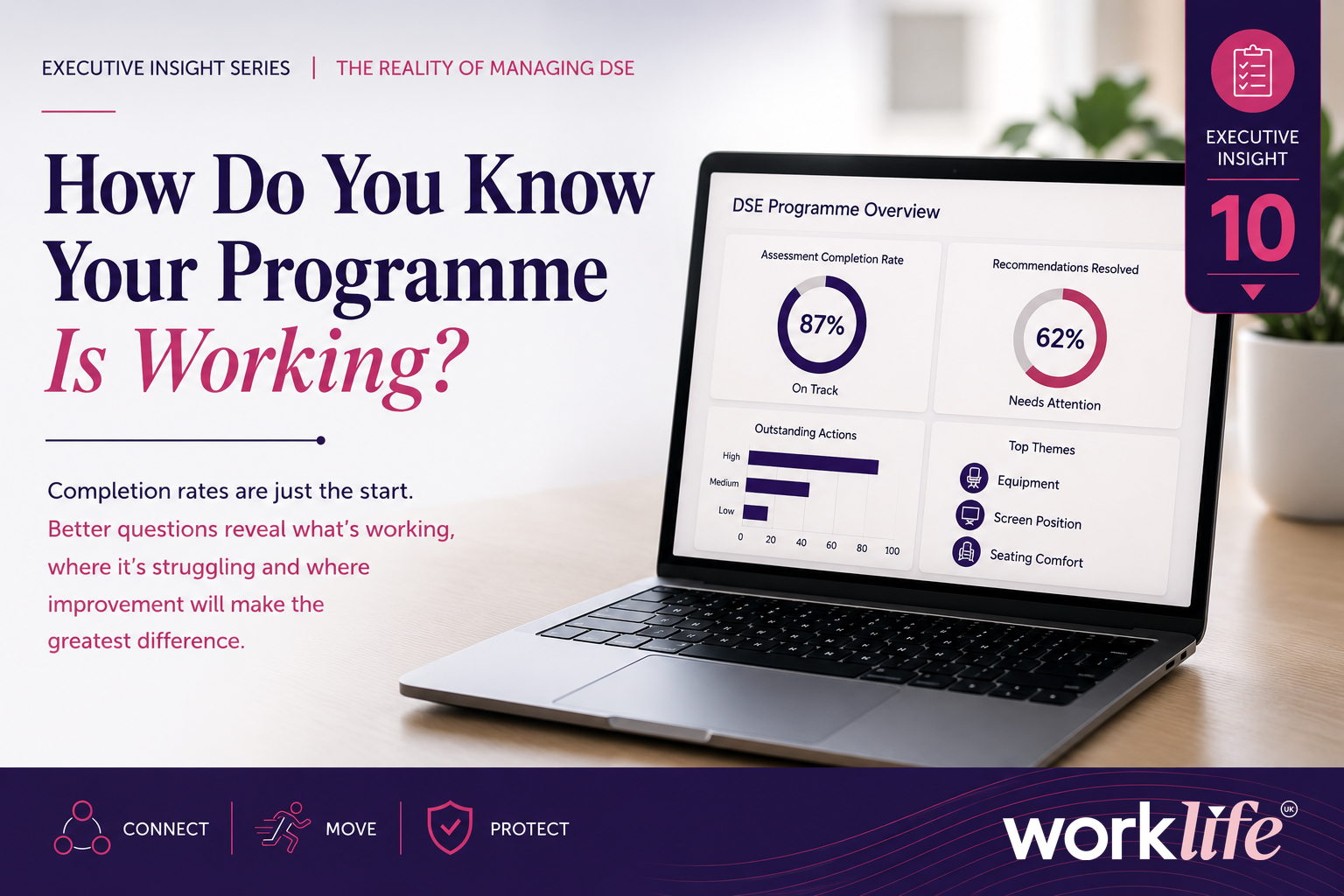
The Reality of Managing DSE
How Do You Know Your Programme Is Working?
Executive Insight 10
Once you have begun to understand how your DSE programme works, another question naturally follows.
How do you know if it is working well?
For many organisations, the most readily available measure is completion. How many employees have completed their assessments? How many are overdue? How quickly are new starters being assessed?
These are useful questions. If employees are not completing assessments, the programme cannot do what it is intended to do. But completion only tells you that something happened. It does not necessarily tell you what happened next.
An organisation might have an excellent assessment completion rate while recommendations remain outstanding, employees wait for support and recurring problems continue unnoticed. Reviewing a DSE programme therefore requires us to look beyond activity and consider effectiveness.
Look at what happens after the assessment
One of the most useful places to start is what happens when an assessment identifies an issue.
Are recommendations being reviewed and straightforward adjustments being resolved? Is equipment being provided where appropriate? Are employees who need additional support reaching the right people? And does anyone know when those actions have been completed?
This is where the difference between managing assessments and managing a programme becomes particularly visible. An assessment may have been successfully completed, but from the employee’s perspective, the process is not complete if the issue they raised has disappeared into the system.
The real measure of the programme is not simply whether the assessment happened. It is whether the programme responded.
Look for patterns, not just individual cases
Individual assessments tell us about individual employees. Taken together, they can tell us something about the organisation.
Perhaps the same equipment is being recommended repeatedly. Maybe employees in a particular location are reporting similar problems. There may be recurring issues among home workers, or a particular stage in the process where recommendations regularly become delayed.
These patterns can help the organisation move from responding to individual cases towards understanding what may be creating them. A recurring equipment recommendation might indicate a wider issue with standard provision. A concentration of problems in one location could suggest something about the working environment. Repeated delays at the same point may reveal a problem with ownership rather than the assessment itself.
This is where DSE information begins to become insight. But that only happens if someone is looking.
Ask better questions
The quality of a programme review often depends on the questions being asked.
Rather than focusing solely on how many assessments have been completed, consider how many identified issues have been resolved. Where are actions becoming delayed? Which employees are waiting for further support? What themes are appearing repeatedly? Are employees experiencing the programme in the way you intended?
These questions shift attention from whether the process is running to whether it is achieving what it was designed to achieve.
For someone who has inherited responsibility for DSE, this can provide a much clearer basis for deciding where to focus attention. You do not need to measure everything. You need enough visibility to understand where the programme is working, where it is struggling and where improvement could make the greatest difference.
Review the programme through different eyes
Data is useful, but it is not the only way to understand whether a programme is working.
Employees may complete assessments but find the process difficult to understand. Managers may receive recommendations without knowing what they are expected to do. The person managing the programme may spend hours manually reconciling information across different systems.
A dashboard might still show a healthy completion rate.
That is why reviewing a programme should involve more than looking at reports. Consider the employee experience, the manager experience and the experience of the person responsible for keeping everything moving.
A programme that appears efficient from one perspective may feel unnecessarily complicated from another. Bringing those perspectives together gives a much more useful picture of how the programme is performing.
Use evidence to champion change
One of the challenges of inheriting a DSE programme is that you may recognise problems long before you have the authority or resources to fix them.
You might know that recommendations are difficult to track, processes are fragmented or too much depends on manual administration. But knowing something feels inefficient is not always enough to secure support for change.
Evidence helps.
If you can show where actions are becoming delayed, how much time is being spent administering the programme or which issues repeatedly appear, the conversation becomes more concrete. You can explain not simply that the programme needs improvement, but why.
That evidence can help build a case for clearer responsibilities, better processes, additional resources or appropriate technology. It also gives you something against which to measure progress when changes are made.
Review should lead somewhere
There is little value in collecting more information simply because it is available. The purpose of reviewing a DSE programme is to help people make better decisions.
Sometimes the result will be a significant change. More often, it may be something relatively small: clarifying a responsibility, changing a communication, improving a handover or addressing a recurring equipment issue.
Over time, these improvements accumulate. The programme becomes easier to manage because the organisation is learning from how it operates.
That is the real value of review. It creates a feedback loop between what the programme does, what the organisation learns and what it improves next.
You do not need a perfect dashboard or an exhaustive set of performance measures to begin. You need enough information to understand whether employees are completing the process, whether identified issues are leading to action, whether those actions are being resolved and where people may be waiting.
The answers will rarely suggest that everything is perfect. That is not the point.
The purpose of review is not to prove that the programme works. It is to understand how well it works and where it could work better.
For someone who has inherited responsibility for DSE, that knowledge can be powerful. It replaces assumption with evidence, provides a clearer sense of where to focus and gives you something essential if you are going to champion meaningful change: a clear picture of where you are today.
Because before you can demonstrate that a programme is improving, you need to know how it is performing in the first place.
About this series
The Reality of Managing DSE is a Work Life UK Executive Insight Series exploring the realities of developing and leading modern DSE programmes.
The series draws on the ideas explored in our book, The Modern DSE Programme: Developing DSE Programmes That Employees Trust and Leaders Value, by Andrew Lodge.
Each Executive Insight explores one of the book’s core themes and considers what it means in practice for the people responsible for workplace DSE.
Coming Next: Better Programmes Create Better Workplaces
