The Reality of Managing DSE
Better Programmes Create Better Workplaces
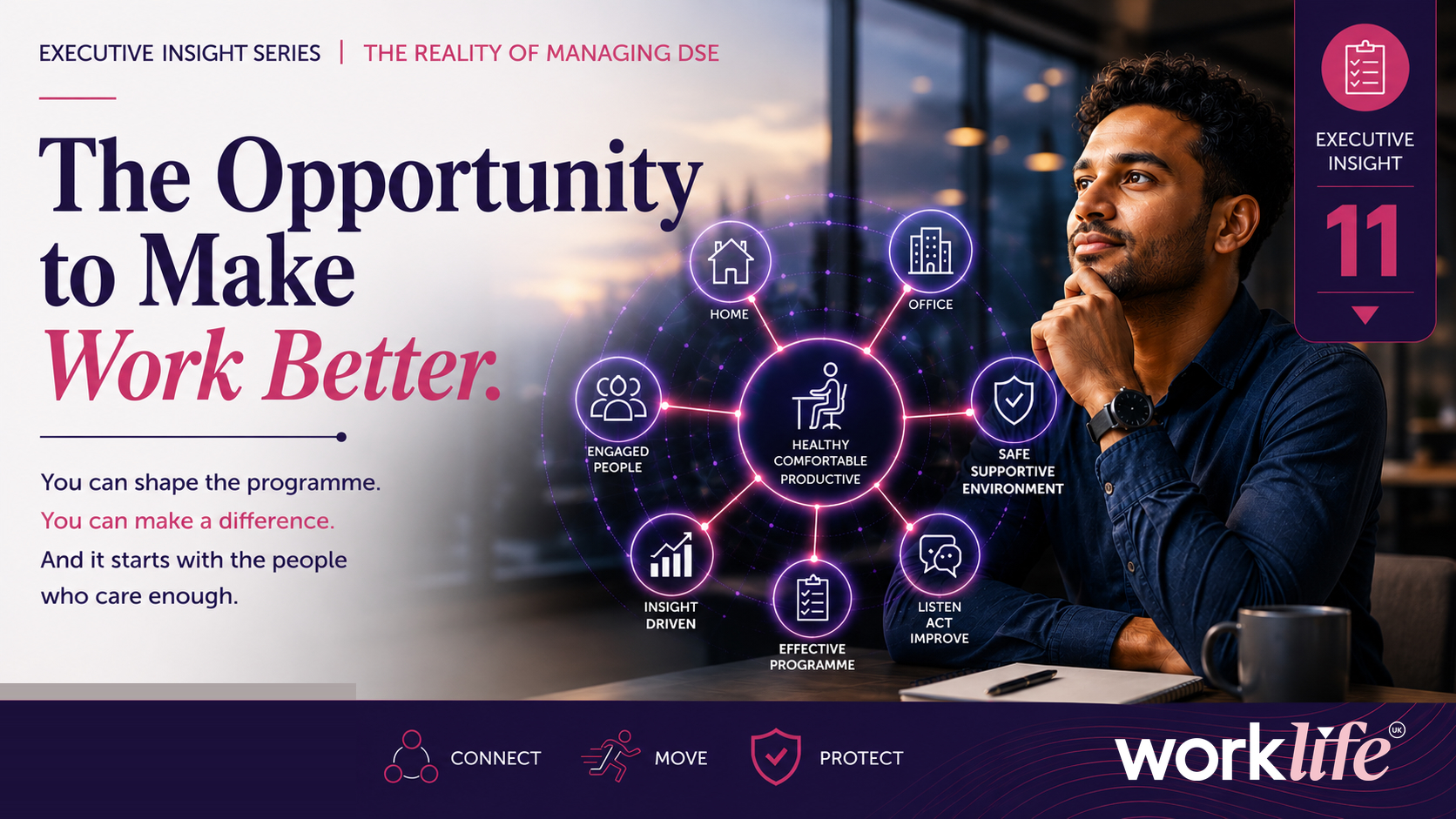
Executive Insight 11
Nobody applies for a job managing DSE.
That is where we began this series. For many people, responsibility for DSE simply arrives. It becomes part of an existing role, accompanied by a process that may have been in place for years and a collection of assessments, spreadsheets, recommendations and responsibilities that have gradually accumulated over time.
At first, the task can feel largely administrative: get the assessments completed, follow up the issues, arrange the equipment and keep the records. But over the course of this series, we have explored a different way of looking at it, because behind every assessment is a person trying to do their best work, and behind every effective DSE programme is someone helping to create the conditions that make that possible.
It was never really about the assessment
Assessments matter. They help employees understand their workstations, identify potential problems and recognise when further support may be needed. But an assessment is only one moment in a much larger experience.
What matters is whether employees engage with the process, whether the programme follows them across the places they work and whether recommendations lead to meaningful action. It matters whether individual needs are treated consistently but not identically, whether managers understand their role and whether those responsible for the programme can see what is happening.
Most importantly, it matters whether employees trust that when they raise an issue, something will happen. That is the difference between running assessments and leading a programme.
The programme you inherited is not the programme you have to keep
Many DSE programmes were built for a different working world. They developed gradually around offices, desktop computers and relatively predictable working patterns. Then work changed. People began working across homes, offices and shared spaces. Technology changed how and where work happens, employee expectations evolved and organisations became more aware of the range of individual needs that workplaces must accommodate.
The programme may have evolved too, but often in pieces. If you have inherited responsibility for one of those programmes, you may have spent much of your time working around its limitations. That does not mean you need to tear everything down and start again. It means you have an opportunity to make it better.
Start by understanding what you have. Follow the employee journey and find the friction. Connect the parts that have become fragmented, improve visibility, clarify responsibility and make sure assessments lead somewhere. Then keep learning, because good programmes are rarely created through a single transformation project. They develop through thoughtful, purposeful improvement.
Small changes can create meaningful progress
One of the risks when we talk about programme design is making improvement sound bigger than it needs to be. Not every organisation needs a complete overhaul.
Sometimes progress begins with a clearer email telling employees what happens after their assessment. It might be a defined escalation route for someone who needs specialist support, a better way of tracking recommendations or a conversation that finally clarifies who owns a particular part of the process.
Individually, these changes can seem small, but together they change the experience. Employees know what to expect, managers know what they need to do and those managing the programme spend less time chasing information and more time acting on it.
Gradually, the programme becomes easier to navigate, easier to manage and easier to trust. That is meaningful progress.
DSE can tell you something about the workplace
A well-managed DSE programme does more than respond to individual workstation issues. It creates a window into how people experience work.
Recurring discomfort may reveal something about standard equipment. Patterns across locations may highlight environmental issues. Repeated requests for support may expose gaps in guidance or training, while difficulties experienced by home workers may tell you something about how effectively hybrid working is being supported.
When organisations begin to see these patterns, DSE becomes more than a compliance process. It becomes a source of insight into where work is creating unnecessary friction and where relatively simple changes could improve the employee experience.
That information has value beyond the person managing DSE. It can inform conversations about workplace design, wellbeing, inclusion, hybrid working, management and organisational culture. But that value can only emerge when the programme is designed to see beyond individual assessments and understand the bigger picture they collectively reveal.
Your role matters
If you are responsible for managing DSE, particularly if you inherited that responsibility rather than chose it, it can be easy to underestimate the influence you have.
You may not control every part of the programme. You may depend on managers, HR, Health and Safety, Facilities, Procurement, Occupational Health or external specialists, and you may need to make the case for investment before some changes can happen. But you are often the person who can see how those parts connect.
You see where employees become stuck, where responsibilities become unclear and where the same problems keep appearing. You can see the opportunities to make things work better, and that perspective gives you the ability to champion change.
That does not mean trying to fix everything at once. It means asking better questions, using evidence, bringing the right people into the conversation and helping others understand what good could look like.
That is leadership, even if nobody ever put it in your job description.
Better programmes create better workplaces
Throughout this series, we have argued that modern DSE programmes should be designed around people rather than processes. They should engage rather than simply record completion, provide one continuous experience wherever people work, make important information visible and provide consistency without losing individuality. Above all, they should ensure that every assessment leads to a meaningful next step.
They should also be reviewed, questioned and improved, not because a DSE programme will ever be finished, but because the workplace will never stop changing.
The organisations that manage DSE well will not necessarily be those with the most complicated processes, the longest policies or the most sophisticated technology. They will be the ones that understand what their programme is trying to achieve and continually improve their ability to achieve it.
When that happens, employees can trust the process because it responds when they need it. Managers can value it because they understand their role. Leaders can have confidence because they can see what is happening. And the person responsible for the programme no longer has to hold everything together through memory, persistence and another spreadsheet.
That is what a modern DSE programme can become.
We began this series with someone who never applied for a job managing DSE. Someone who simply inherited a responsibility and found themselves trying to make sense of a programme that had grown around them.
Eleven Insights later, perhaps the most important message is this: you do not have to simply administer the programme you inherited. You can shape the programme it becomes.
You can make it clearer for the people who use it, more visible for the people who lead it and more effective for the organisation it serves. You can connect what has become fragmented, challenge what no longer works and use what you learn to keep making it better.
Because ultimately, the measure of a great DSE programme is not how efficiently it processes assessments.
It is whether it helps people work well.
And if you have inherited the responsibility for making that happen, you have inherited something else too.
The opportunity to make work better.
Put the ideas into practice
Choose one recent case and trace it from referral to outcome. The five-minute DSE Programme Health Check helps you spot where things work well, where hand-offs are unclear and what could happen next.
Download the five-minute DSE Programme Health Check
If the Health Check highlights a case that needs specialist support, explore a one-off specialist DSE assessment or a virtual home-workstation assessment.
About this series
The Reality of Managing DSE is a Work Life UK Executive Insight Series exploring the realities of developing and leading modern DSE programmes.
The series draws on the ideas explored in our forthcoming book, The Modern DSE Programme: Developing DSE Programmes That Employees Trust and Leaders Value, by Andrew Lodge.
Across eleven Executive Insights, we have explored the principles behind modern DSE programmes and what they mean in practice for the people responsible for making them work.