
The Reality of Managing DSE
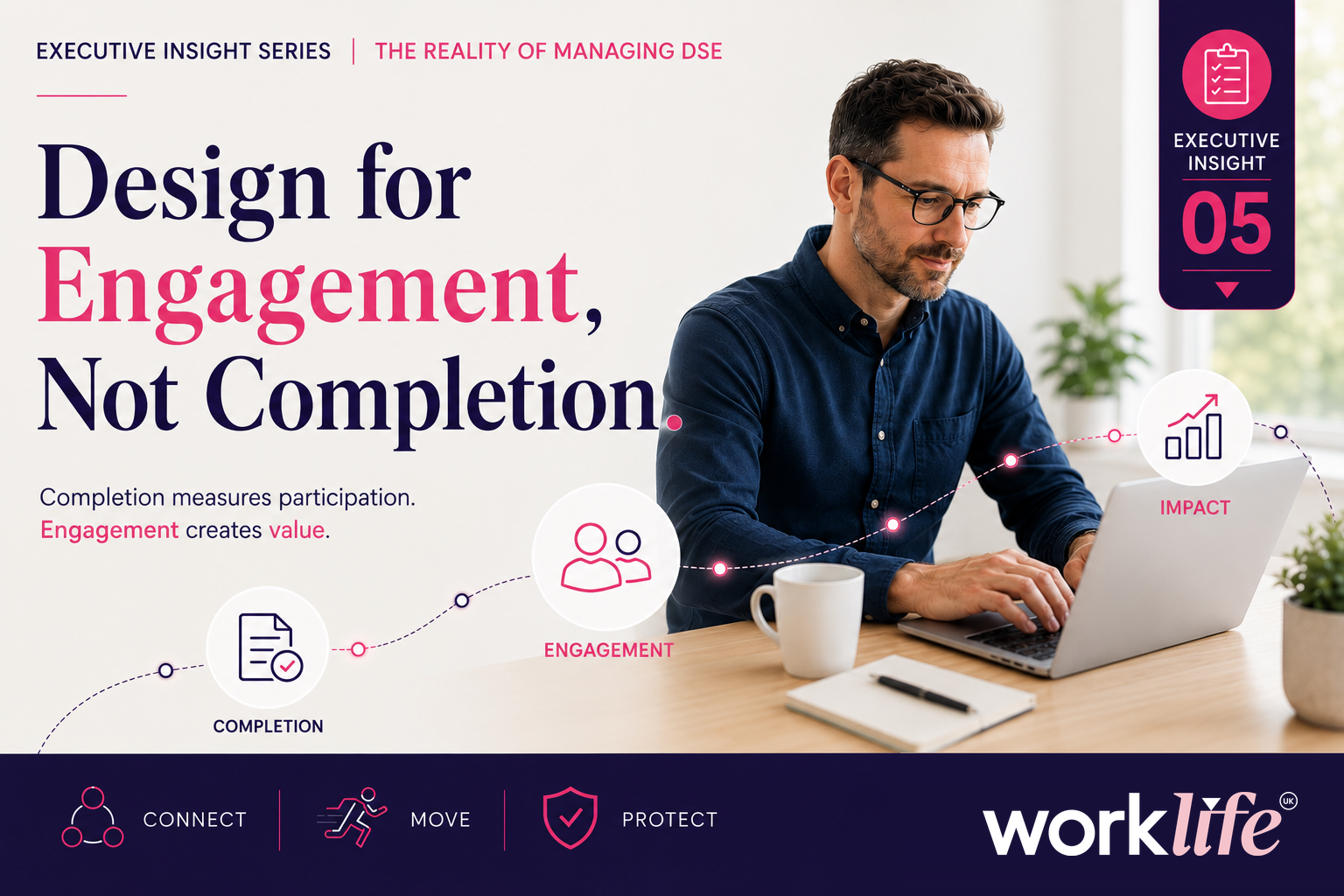
Design for Engagement, Not Completion
Executive Insight 05
Completion rates are one of the easiest things to measure in a DSE programme.
How many employees have completed their assessment? How many are outstanding? Which departments have the highest completion rates?
These are useful questions. Organisations need to know whether assessments are taking place and whether employees are participating in the process. But there is a danger in allowing completion to become the primary measure of success.
An employee can complete an assessment without understanding why they are doing it. They can answer every question, reach the final screen and return immediately to working in exactly the same way as before. The assessment is complete, but the employee may not be engaged at all.
That distinction matters because the real value of a DSE programme does not come from people completing assessments. It comes from what they understand, what they change and what happens as a result.
Completion tells you that someone went through the process. Engagement tells you whether the process meant anything to them.
The completion trap
For those responsible for managing DSE, completion is understandably attractive. It is visible, measurable and easy to report. When completion rates increase, it provides a clear indication that activity is taking place across the organisation.
There is nothing wrong with measuring it. The problem begins when the measure becomes the objective.
When success is defined primarily by the percentage of employees who have completed an assessment, the programme can gradually become designed around achieving that number. Communications focus on reminders, administrative effort goes into chasing outstanding employees and dashboards highlight who has and has not completed the process.
Eventually, the assessment can begin to feel like something employees are required to get through rather than something designed to help them. The employee’s objective becomes completion, the organisation’s objective becomes compliance, and the opportunity to create something genuinely useful can get lost between the two.
Employees engage when they understand the value
Most employees do not arrive at work particularly interested in DSE. They are interested in doing their job.
They want to work comfortably, avoid unnecessary problems and know that support is available if they need it. DSE becomes relevant when the programme connects with those things.
If an employee receives an automated message telling them they must complete a DSE assessment because it is a regulatory requirement, they may well complete it. But if they understand that the process can help them improve how they work, identify potential problems and access support where needed, the conversation changes.
This does not require lengthy campaigns or complicated messaging. Often, it simply requires the organisation to answer a few basic questions clearly. Why am I being asked to do this? How will it help me? What happens if I identify a problem? Will anyone respond?
Employees are much more likely to engage when those questions have clear answers.
The experience matters
The design of the assessment itself also influences engagement.
A process can be technically comprehensive and still create a poor employee experience. Long questionnaires, unclear language and repetitive questions can encourage employees to move through an assessment as quickly as possible. Generic recommendations may feel disconnected from the answers they have provided.
The assessment achieves completion without necessarily creating understanding.
A well-designed experience does something different. It helps the employee recognise why questions are being asked, provides useful information when it becomes relevant and encourages people to think about how they are working. Most importantly, it respects the employee’s time.
If a programme is difficult to access, complicated to understand or burdensome to complete, organisations should not be surprised when employees treat it as an administrative task.
If we want people to engage with DSE, we have to design something worth engaging with.
What happens next matters
One of the clearest tests of engagement comes after the assessment has been completed.
Imagine an employee identifies discomfort and indicates that further support may be required. If nothing appears to happen, the employee learns something about the programme. They learn that completing the assessment does not necessarily lead anywhere.
The next time they receive a reminder, their willingness to engage may be very different.
This is why engagement cannot be separated from follow-up. Employees need confidence that raising an issue will lead to an appropriate response. That does not mean every concern results in new equipment or specialist intervention. A conversation may be required, guidance may be provided or further assessment may be appropriate.
Whatever the outcome, the process needs to feel connected. Every interaction teaches the employee whether the programme is useful, responsive and worth participating in.
Reminders are not an engagement strategy
Most DSE programmes use reminders, and for good reason. People are busy, emails are missed and tasks are postponed.
But there is a difference between using reminders and relying on them.
If completion depends on repeatedly chasing employees, it may be worth asking why the process requires so much chasing. Perhaps employees do not understand why the assessment matters. Perhaps the process feels too long. Perhaps previous experience has taught them that nothing happens afterwards.
More reminders may increase completion, but they do not necessarily address the underlying problem.
Sometimes the most effective way to improve completion is not to become better at chasing people. It is to give them a better reason to participate.
Better engagement creates a better programme
The quality of a DSE programme depends partly on the quality of the information employees provide.
Someone rushing through an assessment simply to complete it may give very different answers from someone who understands the purpose of the questions and believes the organisation will respond appropriately.
Better engagement can therefore produce more meaningful information about how people are working, where difficulties are emerging and what support may be required. Over time, this can help organisations recognise patterns and make better decisions about guidance, training, equipment and workplace design.
It also encourages employees to become active participants in the programme. An organisation cannot observe every employee in every working environment every day. People need to understand how to make straightforward adjustments, recognise when something is not working and know when to ask for help.
The strongest programmes therefore do more than persuade employees to complete an assessment. They help employees participate in managing their own working experience.
Measure completion. Design for engagement.
Completion rates still matter. Organisations should know whether employees are completing assessments and where participation is low.
But completion should be treated as an indicator, not the destination.
A programme with a 95 per cent completion rate may look impressive on a dashboard. But if employees do not understand the purpose of the process, recommendations are routinely ignored and people have little confidence that concerns will be addressed, the number tells us very little about the programme’s effectiveness.
The more useful questions may be harder to reduce to a percentage. Do employees understand why the programme exists? Do they find the process useful? Do they know what to do when something changes? Do they trust that raising an issue will lead to an appropriate response?
So perhaps the question to ask of your own organisation is not simply:
“How do we get more people to complete their DSE assessment?”
But:
“How do we create a DSE programme that people see value in engaging with?”
Because when the experience is useful, relevant and connected to meaningful outcomes, completion becomes less of a battle. It becomes a consequence of good programme design.
About this series
The Reality of Managing DSE is a Work Life UK Executive Insight Series exploring the realities of developing and leading modern DSE programmes.
The series draws on the ideas explored in our book, The Modern DSE Programme: Developing DSE Programmes That Employees Trust and Leaders Value, by Andrew Lodge.
Each Executive Insight explores one of the book’s core themes and considers what it means in practice for the people responsible for workplace DSE.
Coming Next: Be Consistent in Process. Personal in Experience.
