
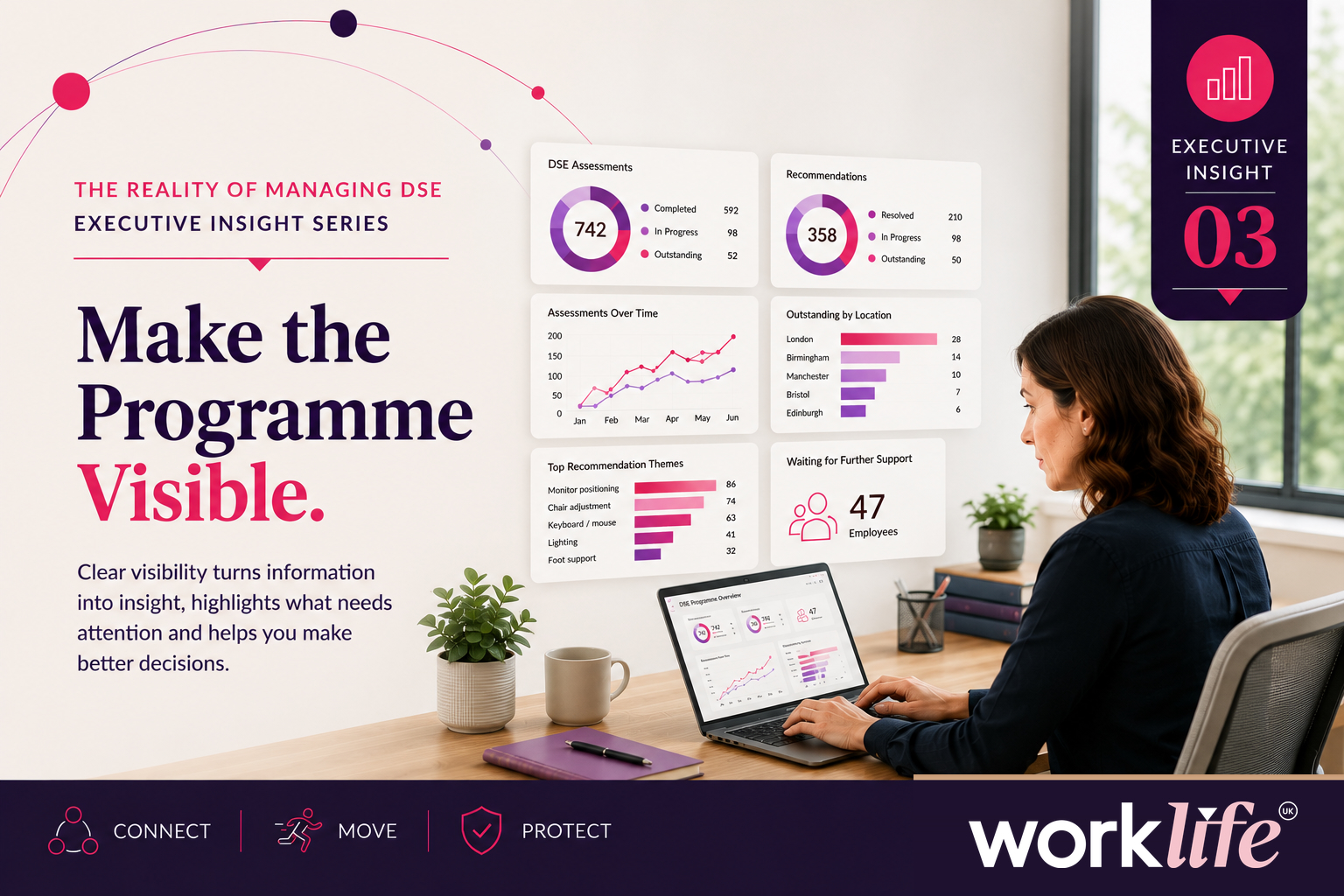
The Reality of Managing DSE
Make the Programme Visible
Executive Insight 03
One of the most common frustrations in managing DSE is not a lack of information.
It is the difficulty of seeing it.
Most organisations already hold significant amounts of information about their DSE programme. Assessments have been completed. Recommendations have been made. Equipment has been requested. Employees have received support. Specialist assessments may have taken place.
The information exists.
The challenge is often bringing it together in a way that allows someone to understand what is actually happening across the programme.
When information sits in different spreadsheets, email chains, assessment reports and individual records, even relatively simple questions can become surprisingly difficult to answer.
How many assessments are outstanding?
Which recommendations have not yet been resolved?
Where are employees waiting for further support?
Are particular issues appearing repeatedly?
Are some teams or locations experiencing more problems than others?
And perhaps most importantly:
Where should we be focusing our attention?
Without clear visibility, answering these questions often requires someone to manually piece together information from several different sources.
That takes time.
But it also creates a more significant problem.
It makes the programme harder to lead.
Visibility changes the conversation
When programme owners can see what is happening, they can begin to move beyond administration.
Instead of simply knowing how many assessments have been completed, they can understand what those assessments are telling them.
They can see where recommendations remain unresolved, where further intervention may be required and where patterns are beginning to emerge.
A recurring issue with monitor positioning may indicate a need for better employee guidance.
Repeated requests for similar equipment may suggest an opportunity to review standard provision.
A concentration of concerns within a particular team may point towards a wider workplace issue that deserves attention.
Individually, these may appear to be isolated cases.
Collectively, they can tell a story.
But only if the programme allows someone to see them.
Information is not the same as insight
Many DSE programmes generate large amounts of data.
The difficulty is that data alone does not necessarily create understanding.
A spreadsheet containing hundreds of assessment records may provide detailed information about individual employees, but it does not automatically tell the person responsible for the programme what they need to know.
Visibility comes from turning information into something useful.
That means being able to identify what requires attention, understand what is changing and recognise where action may have the greatest impact.
The goal is not to create more reports.
It is to make better decisions.
Different people need different levels of visibility
Not everyone involved in a DSE programme needs to see the same information.
The person responsible for day-to-day administration may need to know which assessments are outstanding and which recommendations require follow-up.
A manager may need to understand what actions are expected within their team.
Health and Safety or HR may need to identify recurring themes or areas of concern.
Senior leaders may simply need confidence that the programme is operating effectively and that significant issues are being identified and addressed.
A well-managed programme makes the right information available to the right people at the right level.
This matters because visibility supports accountability.
When responsibilities are clear and progress can be seen, it becomes easier to understand what needs to happen next and who needs to make it happen.
From reactive to proactive
Without visibility, DSE management can easily become reactive.
An employee raises a concern.
Someone investigates.
A recommendation is made.
Equipment is purchased.
The issue is resolved.
Then the process starts again with the next employee.
Each individual receives support, but the organisation may learn very little from the pattern of issues appearing across the workforce.
Greater visibility creates the opportunity to work differently.
Instead of responding only to individual cases, organisations can begin to identify recurring themes and address some issues before they become problems.
Training can be improved.
Guidance can be updated.
Standard equipment can be reviewed.
Managers can receive better support.
Resources can be directed towards the areas where they will make the greatest difference.
This is where DSE information begins to create organisational value.
Visibility does not mean surveillance
There is an important distinction here.
Making a programme visible does not mean exposing unnecessary personal information or creating a system of employee surveillance.
DSE programmes often involve sensitive information about individual circumstances and needs. That information should always be handled appropriately and only shared where there is a legitimate reason to do so.
Programme visibility is about understanding the health of the system.
It is about knowing whether assessments are taking place, whether recommendations are being addressed, whether employees are receiving appropriate support and whether patterns are emerging that the organisation should understand.
The objective is not to know everything about everyone.
It is to know enough about the programme to manage it well.
A programme you can see is a programme you can improve
The strongest DSE programmes do more than collect information.
They use it.
They make it possible for those responsible for the programme to understand what is happening, identify where attention is needed and make informed decisions about what happens next.
Because when information remains fragmented, programme owners are forced to manage individual cases.
When information becomes visible, they can begin to manage the programme itself.
So perhaps the question to ask is not:
“Do we have the information?”
But:
“Can we see what it is telling us?”
The difference between those two questions can fundamentally change the way a DSE programme is managed.
About this series
The Reality of Managing DSE is a Work Life UK Executive Insight Series exploring the realities of developing and leading modern DSE programmes.
The series draws on the ideas explored in our book, The Modern DSE Programme: Developing DSE Programmes That Employees Trust and Leaders Valueby Andrew Lodge.
Each Executive Insight explores one of the book’s core themes and considers what it means in practice for the people responsible for workplace DSE.
Coming Next: Your Programme Doesn’t Stop at the Office Door
