
The Reality of Managing DSE
Understand Before You Improve
Executive Insight 09
Once you begin to see the gaps in a DSE programme, the natural instinct is to start fixing them.
A new assessment system might help. Perhaps the organisation needs better reporting, clearer guidance or a different process for equipment. Maybe managers need more training or responsibilities need to be reassigned.
Any of those things may ultimately be part of the answer.
But before deciding what needs to change, there is a more important first step:
Understand how the programme actually works today.
This can be harder than it sounds, particularly when you have inherited responsibility for a programme that has developed over many years. There may be a documented process, but the way things happen in practice can be quite different.
Understanding that reality is one of the most useful things you can do before trying to improve it.
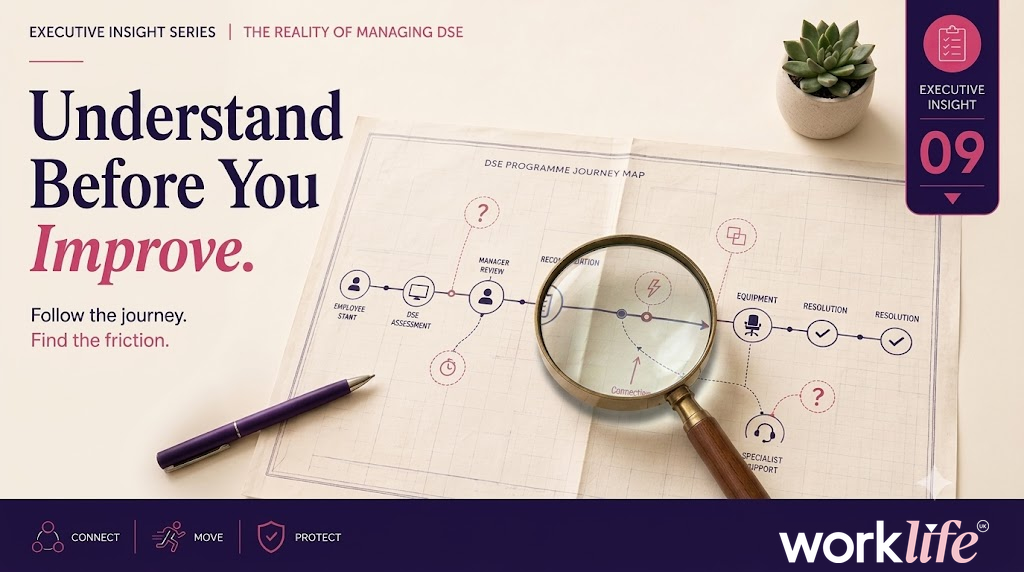
Follow the journey, not just the procedure
Most organisations can describe their DSE process at a high level.
An employee completes an assessment. Issues are identified. Recommendations are made. Actions are taken.
On paper, the journey may appear straightforward.
The reality often becomes visible when you follow an actual employee through it.
What happens when they identify discomfort? Who receives that information? How quickly does someone respond? If equipment is recommended, who approves it and who orders it? What happens if the employee works from home? When does a standard assessment become a specialist one? How does anyone know when the issue has been resolved?
Following the journey in this way often reveals something a process document cannot.
It reveals the gaps between the steps.
Those gaps are frequently where the greatest frustration exists, both for employees and for the person trying to manage the programme.
Try it with a real case
Follow one DSE concern from start to outcome
Use this five-minute reflection to trace a case from referral through to follow-up, then consider what programme leaders can see.
Download the one-page reflection
One-page PDF · No sign-up required
Find the friction
You do not need a large consultancy project to begin understanding your programme.
Start by looking for friction.
Where do employees regularly ask what happens next? Where do managers seem unsure about their responsibilities? Which recommendations take the longest to resolve? What information do you repeatedly have to search for manually?
You may find that the assessment itself works perfectly well, but equipment approval creates delays. Perhaps the escalation route for complex cases is unclear. Maybe home workers follow a different process that nobody is quite sure how to track.
These are useful discoveries because they change the improvement conversation.
Instead of asking:
“What should we add to our programme?”
you can begin asking:
“What is preventing the programme from working as well as it could?”
That is a much more focused question.
It also makes change easier to champion. Rather than presenting colleagues or senior leaders with a broad proposal to “improve DSE”, you can identify a specific problem, explain its impact and show how a targeted change could improve the experience.
Need help with a case now?
Choose specialist support for a more complex workstation need, or a standard virtual home assessment. We’ll check the requirements and confirm the scope and fee before booking.
Listen to the people who experience the programme
The person responsible for DSE sees the programme from one perspective.
Employees see another.
Managers, assessors, Facilities, HR, Health and Safety, Procurement and Occupational Health may each experience a different part of the same journey.
That means some of the most useful information about how the programme works already exists within the organisation.
A manager may tell you that they receive recommendations but are unsure what they are expected to approve. An employee may explain that they completed an assessment but heard nothing afterwards. Procurement may be receiving equipment requests without enough information to understand why they have been recommended.
None of these observations necessarily means someone is doing something wrong.
They may simply reveal that the connections between parts of the programme are not clear enough.
Listening to those experiences can help you distinguish between a problem with an individual and a problem with the system.
That distinction matters when trying to create lasting change.
Build the case for improvement
For someone who has inherited responsibility for DSE, recognising what needs to change is only part of the challenge.
You may also need to persuade other people that the change is necessary.
This is where understanding the programme becomes particularly valuable.
It is easier to champion change when you can describe the problem clearly. Instead of saying that the DSE process feels inefficient, you can show that recommendations regularly become stuck at a particular stage. Instead of arguing that visibility needs to improve, you can explain why it currently takes several hours to answer a straightforward question about outstanding actions.
You can begin to connect programme weaknesses with consequences that matter to different stakeholders: employee experience, management time, delayed support, unnecessary cost or organisational risk.
The conversation moves away from personal opinion and towards evidence.
That does not mean you need perfect data before making an improvement. Often, a combination of programme information, employee experience and practical observation is enough to identify where attention is needed.
The aim is to create a credible case for change.
Improve what matters most
Once you understand the programme, the temptation may still be to tackle everything.
Resist it.
A programme that has developed over many years is unlikely to be transformed overnight, and attempting to change too much at once can create its own problems.
Instead, identify the points where improvement will make the greatest difference.
Perhaps employees need clearer communication after completing an assessment. Perhaps managers need a defined escalation route. Maybe outstanding recommendations need to become more visible, or the organisation needs a consistent way to determine when specialist support is appropriate.
Fixing one meaningful point of friction can begin to change how the programme feels.
It can also create momentum.
People are more likely to support further change when they can see that an improvement has made something easier, clearer or more effective.
Start with understanding
Inheriting a DSE programme can create pressure to demonstrate progress quickly.
But progress does not always begin with adding something new.
Sometimes it begins by understanding what you already have.
Follow the employee journey. Find the points of friction. Listen to the people involved. Understand where responsibility becomes unclear and where information becomes difficult to see.
Then decide what needs to change.
Because the goal is not to build the most elaborate DSE programme.
It is to build one that works.
And the best place to start improving any programme is by understanding how it works today.
About this series
The Reality of Managing DSE is a Work Life UK Executive Insight Series exploring the realities of developing and leading modern DSE programmes.
The series draws on the ideas explored in our book, The Modern DSE Programme: Developing DSE Programmes That Employees Trust and Leaders Value, by Andrew Lodge.
Each Executive Insight explores one of the book’s core themes and considers what it means in practice for the people responsible for workplace DSE.
Coming Next: How Do You Know Your Programme Is Working?
