
The Reality of Managing DSE
What Does a Modern DSE Programme Actually Look Like?
Executive Insight 08
When you inherit responsibility for a DSE programme, it can be difficult to know what good actually looks like.
You may have an assessment process that has been in place for years. There may be spreadsheets, forms, reports and equipment procedures. Different teams may be involved at different stages, and some parts of the programme may work extremely well.
The difficulty is seeing how everything fits together.
This is particularly challenging when the programme has evolved gradually. Processes are rarely designed from scratch. They accumulate. A new form is introduced. A homeworking process is added. Someone creates a spreadsheet to track recommendations. A specialist assessment pathway develops because a particular need arises.
Each addition may have made sense at the time, but eventually the person responsible for DSE can find themselves managing a collection of processes rather than one coherent programme.
So what does a modern DSE programme actually look like?
Perhaps the simplest answer is this:
It feels like one connected experience, even when many different people and processes sit behind it.
Start with the employee journey
From an employee’s perspective, a DSE programme should be relatively easy to understand.
They should know when they need to complete an assessment, why it matters and what is expected of them. If the assessment identifies something straightforward, they should receive useful guidance and understand what adjustments they can make themselves.
If further action is required, the next step should be clear.
The employee should not need to understand the internal structure of the organisation to receive support. They should not have to work out whether their issue belongs with their manager, HR, Health and Safety, Facilities, Procurement or Occupational Health.
Those functions may all play an important role behind the scenes, but the employee’s experience should still feel connected.
This is one of the clearest signs of a well-designed programme. Complexity may exist within the organisation, but the programme does not pass that complexity on to the employee.
The person managing it needs a clear view too
A modern programme also needs to work for the person responsible for managing it.
That means being able to see more than how many assessments have been completed. It means understanding where employees are within the process, which actions remain outstanding and where further support may be needed.
It also means having confidence that there are clear pathways when circumstances become more complex.
You should not need to reinvent the process every time an employee reports discomfort or requires something outside standard provision. The programme should give you enough structure to know what happens next, while retaining enough flexibility to respond appropriately to the individual.
This matters particularly for people who have inherited responsibility for DSE alongside an already busy role. A good programme should reduce the amount of knowledge that exists only in one person’s head.
It should not depend entirely on someone remembering which employee is waiting for equipment, who needs chasing or which manager was supposed to approve a recommendation.
The programme itself should help carry that responsibility.
Good programmes connect the parts
The principles we have explored throughout this series are not separate initiatives.
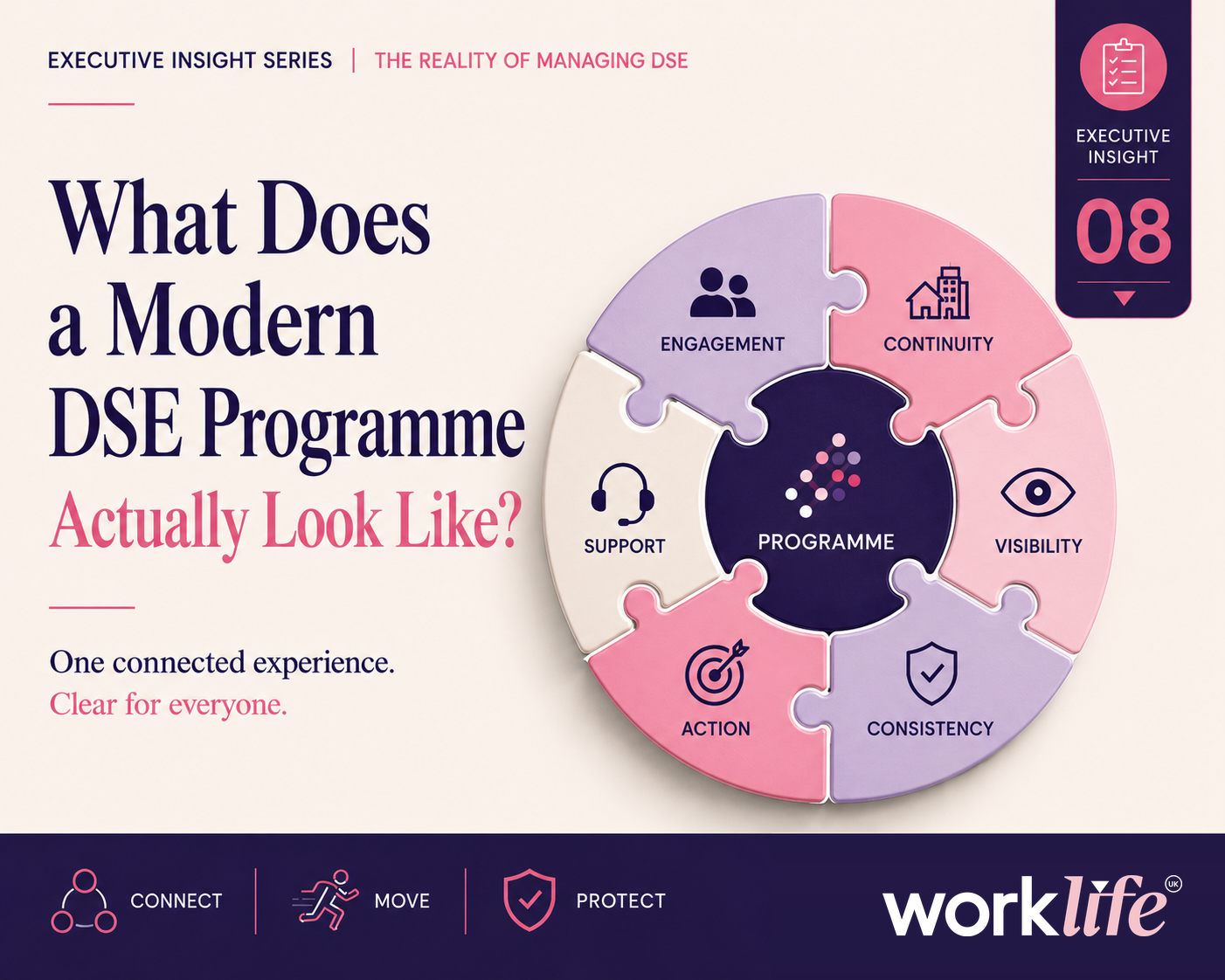
Engagement affects the quality of the information an assessment produces. Visibility helps the organisation understand what that information is telling it. Consistent pathways help people make fair decisions. Clear next steps ensure recommendations move towards action, while a continuous experience prevents employees from becoming lost between locations, teams or processes.
The value comes from connecting those elements.
Technology can help. So can good reporting, clear policies, trained managers and specialist support. But none of those things, individually, creates a modern DSE programme.
The programme is the way they work together.
That is an important distinction when considering change. It can be tempting to assume that improving DSE means replacing the assessment tool or introducing a new system. Sometimes that may be appropriate, but technology cannot compensate for unclear responsibilities, fragmented pathways or a process that employees do not understand.
The starting point is good programme design. The tools should support it.
You do not need to fix everything at once
When you begin looking at DSE as a programme rather than a series of assessments, it can initially make the task feel larger.
Suddenly, you can see more of it.
You notice the gaps between teams, the recommendations that are difficult to track and the exceptions that rely on someone knowing what to do. You may begin to recognise processes that have developed for historical reasons but no longer fit the way people actually work.
That can feel overwhelming, particularly if you have inherited the programme rather than designed it.
But seeing the whole programme does not mean you need to rebuild the whole programme.
Often, the most valuable improvements are relatively focused. Clarifying who owns a particular next step. Creating a clearer escalation pathway. Improving the way outstanding recommendations are tracked. Giving employees better guidance. Helping managers understand their role.
Small improvements to the connections between parts of the programme can have a disproportionately large impact on how the whole thing works.
A programme people can trust
Perhaps the best test of a modern DSE programme is not how sophisticated the technology is or how detailed the process map looks.
It is whether people can trust it.
Can employees trust that raising an issue will lead somewhere?
Can managers understand what is expected of them?
Can those responsible for the programme see what requires their attention?
Can leaders have confidence that significant issues are being identified and addressed?
And can the person managing DSE spend less time holding the programme together manually and more time improving it?
A modern DSE programme does not need to be perfect. It needs to be understandable, connected and capable of learning.
If you have inherited something that feels fragmented, the goal is not to create complexity in the pursuit of improvement.
It is to make the programme easier to navigate, easier to manage and easier to trust.
Because when the parts begin to work together, DSE stops feeling like a collection of assessments and starts behaving like a programme.
About this series
The Reality of Managing DSE is a Work Life UK Executive Insight Series exploring the realities of developing and leading modern DSE programmes.
The series draws on the ideas explored in our book, The Modern DSE Programme: Developing DSE Programmes That Employees Trust and Leaders Value, by Andrew Lodge.
Each Executive Insight explores one of the book’s core themes and considers what it means in practice for the people responsible for workplace DSE.
Coming Next: Understand Before You Improve
