
The Reality of Managing DSE
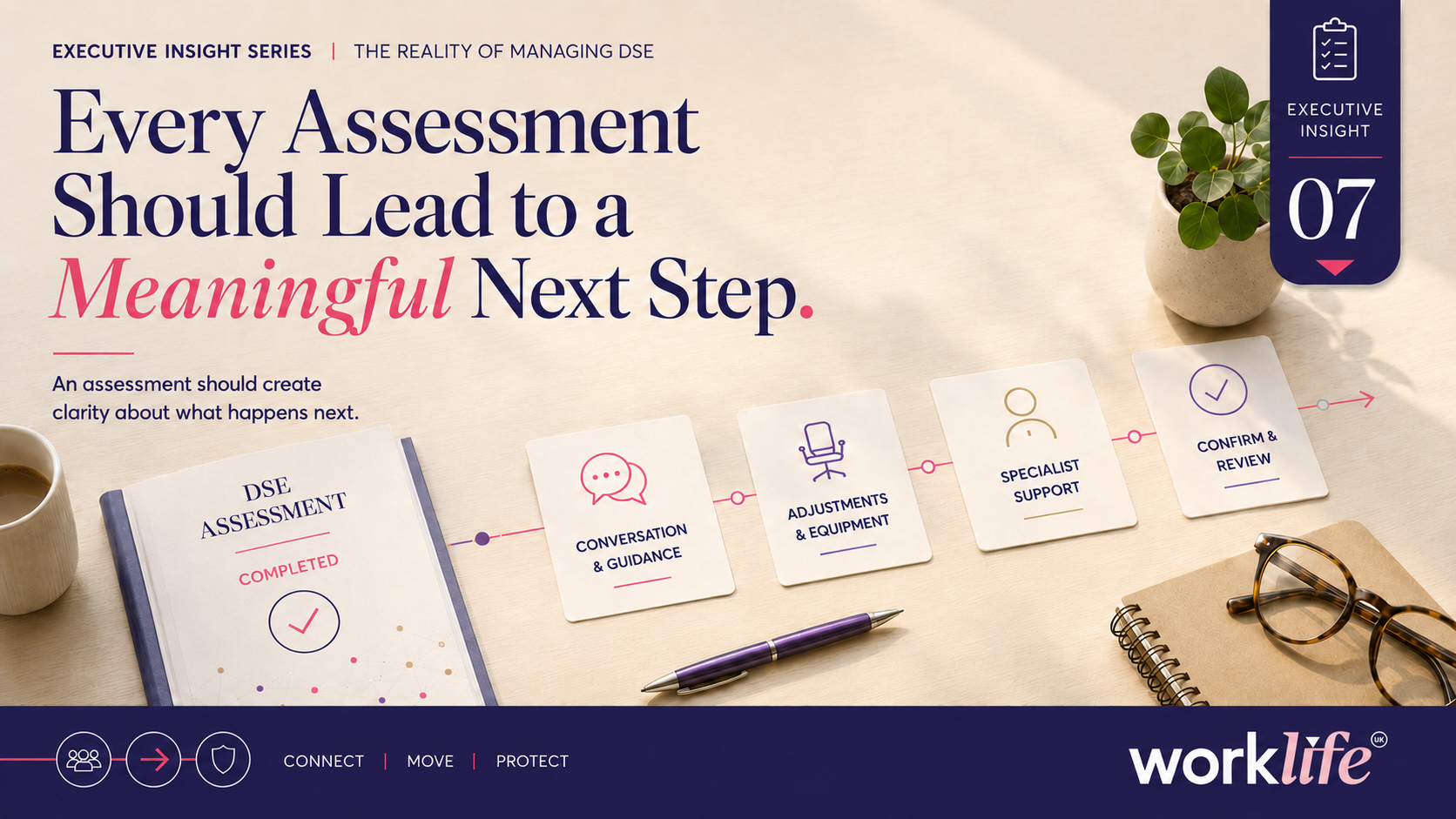
Every Assessment Should Lead to a Meaningful Next Step
Executive Insight 07
Completing a DSE assessment should create clarity.
For many employees, the next step will be simple. They may receive guidance, make a few adjustments to their workstation and continue working comfortably. For others, the assessment may identify something that requires further attention. Equipment may need to be considered, the employee may be experiencing discomfort, or their circumstances may be more complex and require specialist support.
Whatever the outcome, one principle should remain the same: the employee should understand what happens next.
This sounds straightforward. In practice, it is one of the places where DSE programmes can become surprisingly difficult to manage. An assessment is completed, a recommendation is recorded, an email is sent or a request is passed to another team. For the employee, the assessment may feel complete, but the issue that brought them into the process may not be. For the organisation, the assessment may appear on a report as completed, even though the action arising from it remains outstanding.
The danger is that completion becomes confused with resolution.
They are not the same thing.
An assessment is a point in the journey
DSE assessments are important, but their value lies in what they help the organisation and employee do next.
Sometimes that next step is simply reassurance. The employee understands their workstation, makes the necessary adjustments and knows what to do if their circumstances change. Sometimes an action is required: a monitor needs repositioning, a different input device may be appropriate or a chair needs adjusting or replacing.
In other cases, the assessment may identify that the employee’s needs cannot be addressed through the standard process alone. The appropriate next step might then be a specialist DSE assessment, Occupational Health input or another form of professional support.
In each case, the assessment has done its job because it has created clarity about what should happen next.
Problems arise when the programme is good at identifying issues but less effective at moving them towards an outcome.
Recommendations need somewhere to go
Most DSE programmes generate recommendations. The challenge is what happens to them afterwards.
Who reviews the recommendation and decides what action is appropriate? Who communicates with the employee? Who arranges equipment? Who checks whether the recommendation has actually been implemented?
These questions become particularly important when responsibility for DSE is spread across several teams. An assessor may identify the need, a manager may approve an action, Procurement may arrange equipment and Facilities may install it. Occupational Health or another specialist may become involved if the situation is more complex.
Each part of that process may work perfectly well in isolation. The difficulty is ensuring the employee can move through the whole journey without becoming responsible for joining those parts together themselves.
A strong DSE programme therefore creates clear ownership of the next step. That does not mean one person must manage every action. It means the programme should make it clear where responsibility sits as the employee moves through it.
Closing the loop matters
There is an important difference between making a recommendation and knowing that it has been resolved.
Equipment may have been ordered but not delivered. Guidance may have been sent but not understood. A specialist assessment may have been recommended but never arranged. An adjustment may have been made but failed to resolve the employee’s concern.
If the programme stops at the recommendation, it may never know the difference.
Closing the loop does not need to create a large administrative burden. In many cases, it may simply mean being able to see whether an action is outstanding, in progress or complete. Where the situation is more complex, it may mean checking back with the employee to understand whether the action taken has actually helped.
This is where programme visibility becomes important again. Knowing how many assessments have been completed tells us something. Knowing how many employees are still waiting for the support identified by those assessments tells us considerably more.
The next step should be proportionate
There is a risk that improving follow-up simply creates another layer of process. It does not need to.
Most employees will not need complex case management. The goal is simply to make sure that when an assessment identifies something requiring action, there is a clear and proportionate route forward.
For a straightforward issue, that might mean immediate guidance. For an equipment recommendation, it might mean a defined approval and ordering process. Persistent discomfort may require escalation to someone with the appropriate expertise, while a more complex individual need may require the programme to recognise that the standard pathway has reached its limit and specialist support is needed.
Different situations require different responses. What matters is that the programme does not leave either the employee or the person managing it wondering what happens next.
Completion is not the destination
It is understandable that organisations measure assessment completion. Completion rates are visible, easy to report and provide a useful indication of participation.
But a programme can achieve a very high completion rate while still leaving recommendations unresolved and employees waiting for support.
That is why the strongest DSE programmes look beyond the assessment itself. They consider the journey from identification to action and, where appropriate, resolution.
The question is not simply:
“Has the assessment been completed?”
It is:
“Did the assessment lead to the right next step?”
That shift may appear small, but it changes what the programme pays attention to. It moves the focus from recording activity towards creating outcomes.
Because an assessment should never become a dead end. It should create understanding, provide direction and make the next step clear.
Every assessment should lead to a meaningful next step.
About this series
The Reality of Managing DSE is a Work Life UK Executive Insight Series exploring the realities of developing and leading modern DSE programmes.
The series draws on the ideas explored in our book, The Modern DSE Programme: Developing DSE Programmes That Employees Trust and Leaders Value, by Andrew Lodge.
Each Executive Insight explores one of the book’s core themes and considers what it means in practice for the people responsible for workplace DSE.
Coming Next: What Does a Modern DSE Programme Look Like?
