
The Reality of Managing DSE
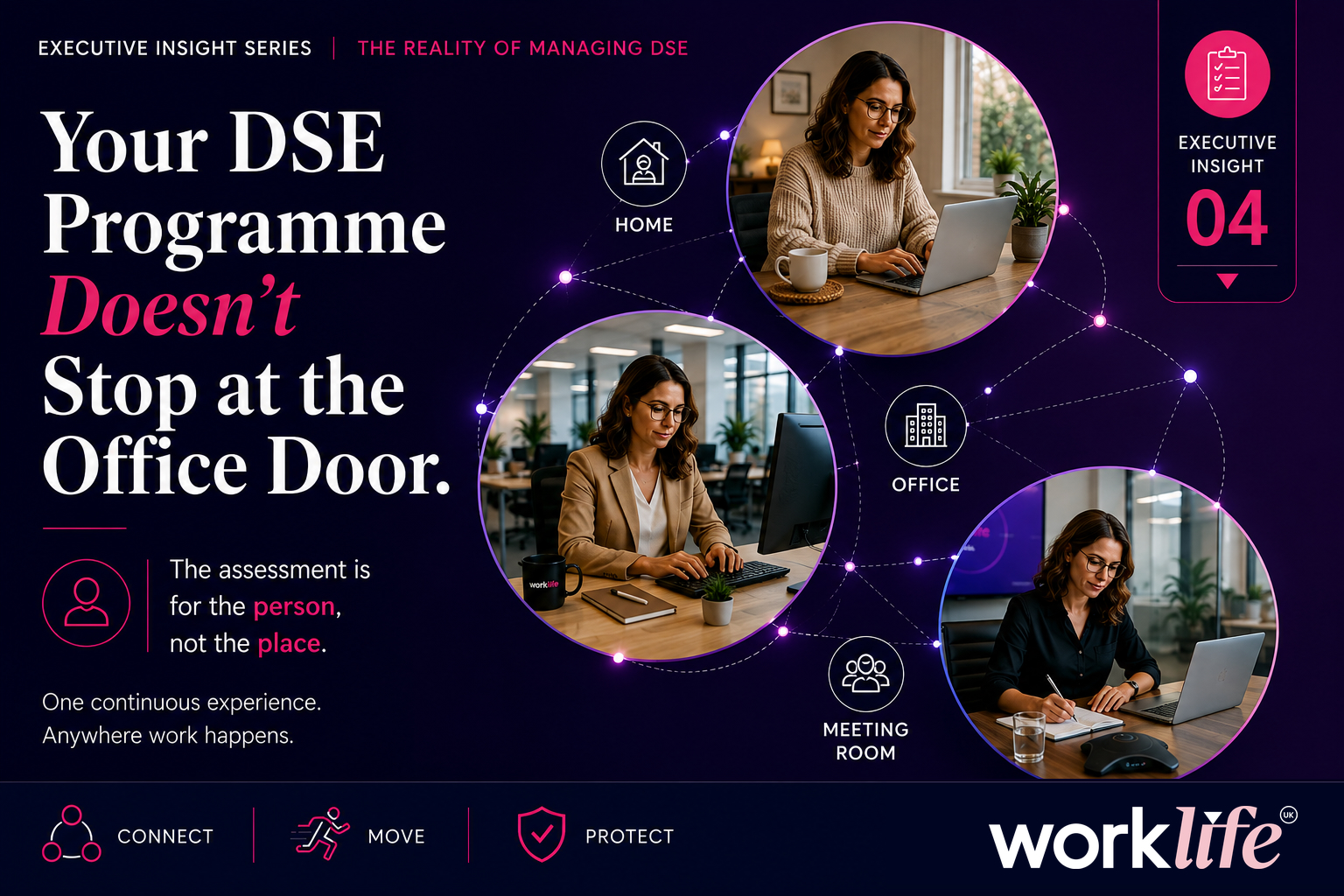
Your Programme Doesn’t Stop at the Office Door
Executive Insight 04
Hybrid working has changed the way organisations think about DSE.
When most employees worked from a single office, managing DSE could be closely connected to the physical workplace. Assessments related to particular workstations, equipment remained in one location and managers worked alongside their teams. Straightforward issues could often be resolved through informal conversations because the employee, their manager and their workstation existed within the same environment.
Today, the picture is very different.
An employee might spend Monday and Tuesday at home, Wednesday at a client site and the rest of the week in the office. Another may work almost entirely remotely. New employees may spend their first weeks with an organisation without ever visiting a central workplace.
The places in which people work have changed, but in many organisations the DSE programme has struggled to change with them.
The result is often a collection of processes designed around different locations. There is an office assessment, a homeworking assessment and perhaps another process for hybrid workers. New starters may follow one route, while employees experiencing discomfort enter another. Specialist assessments sit somewhere else again.
Each process may make perfect sense when considered individually. The difficulty appears when we look at the experience of the employee moving between them.
Your employees may work in different places. They should not have to navigate different DSE programmes because of it.
Hybrid working didn’t create the problem
It is tempting to think that hybrid working made DSE management more complicated. In many ways, it did. Organisations have less direct visibility of how people are working. Managers may rarely see the workstations used by members of their teams. Employees have greater responsibility for making decisions about their own working environments.
But hybrid working also exposed a more fundamental issue.
Many DSE programmes were designed around workplaces rather than people.
When everyone worked in the same building, that distinction was almost invisible. The employee and the workstation were effectively connected. If someone moved desk, changed department or required additional support, the organisation could often manage that change within the same physical environment.
Hybrid working broke that connection.
The employee started moving. The programme often didn’t.
This can leave organisations trying to manage a modern workforce through processes designed for a world in which work happened primarily in one place. The challenge, therefore, is not simply to create better homeworking assessments. It is to create a programme capable of following the employee wherever work takes place.
One employee. One programme.
Consider an employee who joins an organisation and initially works from the office. They complete their DSE assessment, make some straightforward adjustments and receive guidance on setting up their workstation.
Six months later, their working pattern changes and they begin working from home three days each week.
What happens next?
In some organisations, the employee effectively starts again. They complete a different assessment. Information from their previous assessment may not follow them. Recommendations made in the office may sit within a separate record. The employee may receive different communications or even interact with an entirely different system.
From an organisational perspective, there may be perfectly understandable reasons for each of these processes. From the employee’s perspective, however, there is only one question:
How do I work comfortably and effectively wherever I happen to be working?
That is why modern DSE programmes need to think in terms of continuity.
The employee remains the constant. Their working environment changes around them.
A well-designed programme recognises that distinction. Information follows the individual, previous recommendations remain relevant and accessible, and changes in working arrangements become part of an ongoing journey rather than triggers for entirely separate processes.
The programme adapts around the employee, rather than requiring the employee to navigate the organisation’s internal complexity.
Consistency doesn’t mean identical workstations
Creating one continuous programme does not mean attempting to recreate the office in every employee’s home. Nor does it mean that every working environment needs to be treated identically.
The realities of different workplaces matter. An employee working from a dedicated home office may have very different needs from someone occasionally working at a kitchen table. A colleague travelling between client sites faces different challenges again.
The objective is not to create identical environments. It is to create a consistent experience of support.
Employees should understand how to access advice wherever they are working. They should know what is expected of them, when to raise a concern and what will happen when they do. Managers should have confidence that the same principles apply regardless of an employee’s location. Those responsible for the programme should be able to understand an employee’s journey without having to piece together information from several disconnected processes.
The location may change. The programme should still feel familiar.
The programme has to travel with the employee
This becomes particularly important as people’s circumstances change.
An employee may begin their career with an organisation working predominantly from the office. Later, they may move to hybrid working, change roles, relocate, develop discomfort, become pregnant, experience an injury or a change in health, or require specialist support.
None of these events exists neatly within the boundaries of an office or homeworking assessment. They are simply changes in the employee’s working journey.
A programme designed around individual locations can struggle to respond coherently because every change risks moving the employee into another process. A programme designed around people responds differently.
It asks:
What does this employee need now, and what is the appropriate next step within the programme?
That is a much simpler way of thinking about what can otherwise become a surprisingly complicated system.
Technology should connect the experience, not fragment it
Technology has an important role to play.
Digital assessments make it possible to reach employees wherever they work. Centralised records can help information follow the individual. Automated communication can reduce administrative effort, while reporting tools can give programme owners greater visibility across increasingly dispersed workforces.
Used well, technology can make a modern DSE programme significantly easier to manage.
But technology does not automatically create continuity. In fact, it can do the opposite.
If organisations introduce different tools for different parts of the employee journey, technology can reinforce the very fragmentation it was intended to solve. A homeworking assessment sits in one system, office assessments in another, specialist reports arrive by email and equipment requests are managed through a separate procurement process.
Each tool may work perfectly well.
The employee experience can still feel disconnected.
This is why programme design has to come first. Decide what the employee journey should look like. Understand how information needs to move and clarify responsibilities. Then use technology to make that experience easier to deliver.
Not the other way around.
Hybrid working requires greater employee participation
There is another important consequence of work moving beyond the office.
Employees increasingly need to become active participants in their own DSE experience.
In a traditional office, managers and colleagues may notice obvious workstation issues. Someone may see that a monitor is positioned poorly or that a chair has not been adjusted correctly. When an employee works remotely, those informal opportunities for intervention are reduced.
The programme therefore needs to give people the knowledge and confidence to recognise issues themselves. Employees need to understand how to set up different working environments, recognise when something has changed and know when straightforward adjustments are appropriate or when further support should be requested.
This is where engagement becomes particularly important.
A programme that employees understand can extend beyond the physical workplace because the employee carries that understanding with them. A programme that relies entirely on organisational oversight cannot.
The strongest hybrid DSE programmes therefore do more than assess people remotely. They equip people to participate in managing their own working experience.
Design around people, not places
Perhaps the most useful question for anyone responsible for a modern DSE programme is this:
If an employee changed where they worked tomorrow, would they remain within the same programme, or would they enter a different process?
If the answer is the latter, it may be worth considering whether the programme has been designed around the places in which people work rather than the people themselves.
The distinction matters because workplaces will continue to change. Employees will continue to move between locations, working patterns will evolve and new technologies will create new possibilities. Trying to build a separate DSE process for every possible working arrangement will inevitably create complexity.
A better approach is to build one programme capable of adapting.
One employee journey, supported by a programme that continues to work across different environments and changing circumstances.
The employee remains at the centre, and the programme moves with them.
When that happens, hybrid working stops being something the DSE programme has to accommodate as an exception. It simply becomes another part of the way people work.
So perhaps the question to ask of your own organisation is not:
“Do we have a homeworking DSE process?”
But:
“Does our DSE programme work wherever our people do?”
The difference between those two questions may reveal whether your programme has truly adapted to the modern workplace.
About this series
The Reality of Managing DSE is a Work Life UK Executive Insight Series exploring the realities of developing and leading modern DSE programmes.
The series draws on the ideas explored in our book, The Modern DSE Programme: Developing DSE Programmes That Employees Trust and Leaders Value, by Andrew Lodge.
Each Executive Insight explores one of the book’s core themes and considers what it means in practice for the people responsible for workplace DSE.
Coming Next: Design for Engagement, Not Completion
