
The Reality of Managing DSE
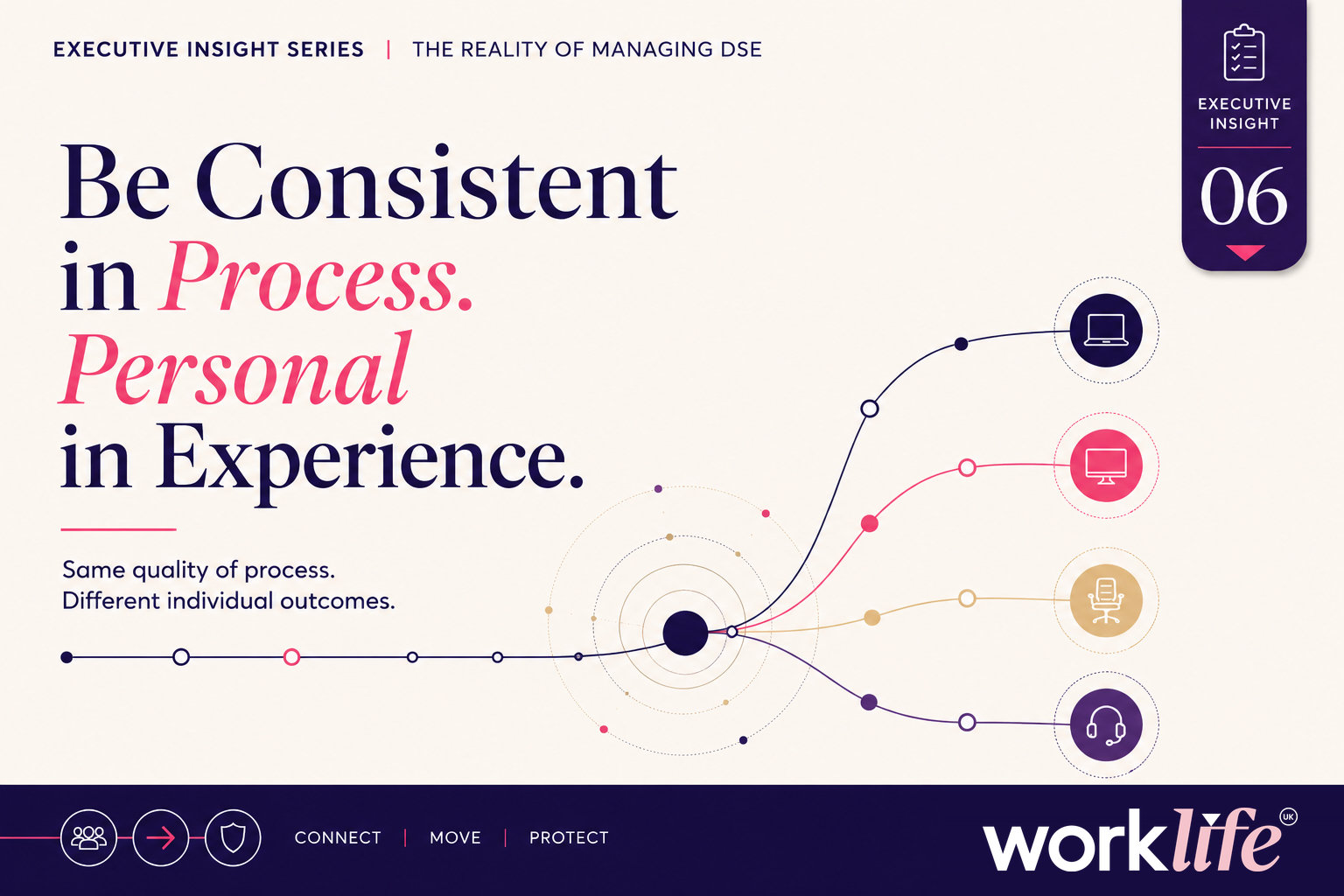
Be Consistent in Process. Personal in Experience.
Executive Insight 06
One of the most difficult balances in managing DSE is the balance between consistency and individual need.
Organisations want employees to be treated fairly. Managers need clear guidance about what they should do. Finance needs confidence that decisions are reasonable and proportionate. Employees, quite rightly, expect their own circumstances to be understood.
All of those expectations are reasonable. The challenge is bringing them together within one programme.
It is easy to assume that consistency means treating everyone in the same way. The same assessment. The same process. The same equipment options. The same response.
But people are not the same.
One employee may complete a DSE assessment, make a few straightforward adjustments and continue working comfortably. Another may need additional guidance or equipment. Someone else may be experiencing persistent discomfort that requires specialist support. Another employee’s needs may be influenced by disability, pregnancy, neurodiversity, injury or a change in their health or working circumstances.
If consistency means giving each of those employees the same response, the programme may be consistent. But it may not be very effective.
Consistency is not about giving everyone the same outcome. It is about giving everyone the same quality of process.
Consistency and uniformity are not the same thing
Uniformity applies the same solution regardless of circumstance.
Consistency applies the same principles while allowing the response to reflect the needs of the individual.
Consider two employees who both report discomfort during their assessment. For one, the issue may be resolved through a conversation about workstation setup and a few simple adjustments. For the other, the circumstances may be more complex and require specialist support.
Treating those employees fairly does not mean treating them identically. It means both concerns are taken seriously, both employees understand what happens next and both cases are considered using the same decision-making principles.
The process is consistent.
The experience is personal.
This distinction matters because individual outcomes can otherwise appear inconsistent. Why has one employee received specialist equipment when another has not? Why has one person been referred for further assessment while someone else has been given guidance?
When the framework behind those decisions is unclear, the conversation becomes focused on the outcome: “Why did they get that?”
A well-designed programme allows the organisation to answer a better question: “How did we decide what support was appropriate?”
Perhaps straightforward adjustments were explored first. Perhaps the employee continued to experience discomfort. Perhaps their needs could not be met through standard provision, or specialist advice was required before an appropriate decision could be made.
The outcome may be different because the circumstances are different. What remains consistent is the way the organisation reached the decision.
Create pathways, not separate programmes
As employee needs become more diverse, there can be a temptation to respond by creating more processes.
A standard DSE process. A homeworking process. A process for discomfort. A pregnancy process. A neurodiversity process. A specialist equipment process.
Each may have been created for a sensible reason. But over time, the result can become increasingly difficult for employees to navigate and equally difficult for those responsible for the programme to manage.
A stronger approach is often to create one clear programme with different pathways available when circumstances require them.
For most employees, the journey may be relatively straightforward. They complete an assessment, receive relevant guidance, make appropriate adjustments and continue working.
Some will need more support.
The programme should recognise when that point has been reached and provide a clear route forward. That might involve a conversation with a manager, further ergonomic guidance, equipment, a specialist DSE assessment or input from Occupational Health or another appropriate professional.
The important thing is that the employee does not suddenly fall out of the programme because their circumstances have become more complex.
The pathway can change while the principles remain consistent.
A framework should support good decisions
No DSE programme can anticipate every situation it will encounter. People are too varied and individual circumstances too complex for every decision to be reduced to a flowchart.
Professional judgement will always have a role.
The objective of a consistent programme should not be to remove that judgement, but to provide a framework that supports it. Clear principles help establish what the organisation is trying to achieve, when additional support should be considered, who should be involved and how decisions should be communicated.
This becomes particularly important when recommendations involve specialist equipment or additional expenditure.
Without a clear process, the conversation can quickly become focused on the cost of an individual item. Why does this employee need an £800 chair when the organisation’s standard chair costs £300?
But price alone tells us very little about whether either chair is appropriate for that particular employee.
The more useful question is whether the proposed solution addresses the employee’s needs and whether the organisation followed a reasonable process in reaching that recommendation.
When the process is clear, individual decisions become easier to understand and explain. Employees can trust that their circumstances will be considered properly, managers have a framework to guide them and those responsible for budgets can understand why resources are being allocated.
Personal does not mean unrestricted
Responding to individual needs does not mean that every request must automatically be approved.
Sometimes an employee may request a particular product when a simpler adjustment would resolve the issue. Further assessment may identify a different solution. A recommendation may need to be explored before a decision is made.
A personal experience means the employee feels heard and their circumstances are considered properly. It also means the organisation can make proportionate decisions based on evidence, professional judgement and the needs of the situation.
This is another reason consistency matters.
When employees understand that decisions are made through a fair and transparent process, different outcomes do not automatically mean unequal treatment.
Fairness comes from the quality of the decision-making process, not from everyone receiving the same answer.
The same quality of process
As workplaces become more diverse, finding this balance will become increasingly important.
Employees work in different locations, perform different roles and have different physical, cognitive and health needs. Trying to create one standard solution that works equally well for everyone is unlikely to succeed. Creating a separate programme for every possible circumstance is equally unrealistic.
A strong DSE programme sits between those two extremes. It provides clear principles and consistent pathways while retaining enough flexibility to respond intelligently to the person in front of it.
So perhaps the question to ask of your own organisation is not:
“Do we treat everyone the same?”
But:
“Can we explain how we make fair and consistent decisions for people with different needs?”
Because the strongest DSE programmes are not those in which everyone receives the same outcome.
They are the programmes in which everyone can expect the same quality of consideration.
Be consistent in process. Personal in experience.
About this series
The Reality of Managing DSE is a Work Life UK Executive Insight Series exploring the realities of developing and leading modern DSE programmes.
The series draws on the ideas explored in our book, The Modern DSE Programme: Developing DSE Programmes That Employees Trust and Leaders Value, by Andrew Lodge.
Each Executive Insight explores one of the book’s core themes and considers what it means in practice for the people responsible for workplace DSE.
Coming Next: Every Assessment Should Lead to a Meaningful Next Step
